Our History
Athens has a storied history to tell with many intriguing elements including Indians, railroads, the infamous Trail of Tears, a private college, divided family loyalties resulting from the Civil War, a major ice cream manufacturer, and a battle of local government corruption that received national attention.
Early Years
During the very early years, the Cherokee Indian tribe was living in present day Athens and McMinn County. Nearby were the Overhill Cherokee villages of Great Tellico to the north and Great Hiwassee to the south. During February 1819, a group of Cherokee Indians, led by Major John Walker, a Cherokee Indian Chief, met with U.S. Secretary of War, John C. Calhoun, and signed the Calhoun Treaty. This negotiated land cession treaty, known as the “Hiwassee Purchase,” sold the Cherokee land between the Hiwassee River, Little Tennessee River, and the Big Tennessee River lying west of Starr Mountain and the foothills of the Great Smoky Mountains, including future McMinn County, to the United States resulting in a vast amount of land ripe for settlement.
The Tennessee legislature was in session in Murfreesboro during November 1819 and was discussing the recent acquisition of the “Hiwassee Purchase.” During this time, the legislature decided that two new counties needed to be created to provide services to the new settlers that will be arriving. During that November, two counties were drawn out from the existing Roane County. The county to the north was named Monroe County in honor of former President James Monroe and the county to the south was named McMinn County in honor of the current governor of Tennessee, Joseph McMinn. The Tennessee legislature formally approved the creation of McMinn County on November 18, 1819. The home of Major John Walker, a Cherokee Indian Chief that assisted in negotiating the Calhoun Treaty, was designated as the place for county government in the present-day town of Calhoun, which was named after John C. Calhoun by Walker. Over time, Polk, Meigs, and Bradley counties were born out of McMinn County.
The town of Athens was created in 1822 on land obtained from William Lowry and Joseph Calloway and consisted of 35 acres bordering on the Eastnalle Creek, a source of waterpower to operate various mills that were located along the waterway. Athens received its official name on August 23, 1822 by the Tennessee legislature. The name of Athens may have been selected by a local commissioner, Elijah Hurst, based on a description of the ancient city in Greece which he had read about. During 1823, the county seat was moved from its original location in Calhoun to Athens to make the seat of local government more accessible to the majority of county citizens.
The railroad was a prominent feature in the growth of Athens. The Hiwassee Railroad received its charter in the mid-1830s to construct a railroad between Knoxville, Tennessee and Dalton, Georgia. Construction began in 1837, was delayed due to financial and legal problems, resumed construction under the name of East Tennessee and Georgia Railroad, and was completed during 1851.
In 1836, U.S. General John E. Wool arrived in Athens to assist in coordinating the voluntary removal of the Cherokee Indians which become a forced removal in 1838 and known as the Trail of Tears.
Pre-Civil War / Civil War
In 1857, a college, known as East Tennessee Wesleyan College, was established in Athens by the Holston Conference of the Methodist Episcopal Church. The college was forced to suspend operations during the Civil War in 1863 but reopened in 1867 under a new name, East Tennessee Wesleyan University governed by the northern branch of the Methodist Church. Over time, the college has operated under several different names including Grant Memorial University named for President Grant after his death, Athens School of the University of Chattanooga, and since 1925, Tennessee Wesleyan College and then Tennessee Wesleyan University in 2016. Today, TWU has a 44-acre campus located in downtown Athens offering over 80 undergraduate and seven graduate degree programs with over 1,100 students.
During the Civil War (1861-1865), McMinn County and Athens were divided as to loyalties resulting in hostilities between family members and friends which lasted for many years. In 1861, McMinn County voted against secession by a narrow 1,144 – 904 margin. Even though no major Civil War battles were fought in the area, Athens was occupied by both Union and Confederate forces. The county sent troops to both the Union army and the Confederate army. General William Tecumseh Sherman was briefly headquartered in Athens at the Bridges Hotel, now the Robert E. Lee Hotel, while preparing his “March to the Sea.”
Post-Civil War
After the Civil War, the railroad brought business and industry to the Athens area including textile mills, flour mills, timber mills, dairy farms, and later furniture and appliance factories. In 1870, T.B. Mayfield Sr. started a small family dairy farm raising and selling Jersey cows. Later in 1910, T.B. Mayfield, Jr. continued the family business and started selling milk to local residents. In 1922, Mayfield’s opened a new production facility capable of pasteurizing milk, in 1923 opened the Mayfield Creamery, and in 1950 expanded their operation. Over the years, Mayfield Dairy becomes a major industry in Athens and the Southeast U.S. During the 1920s, many other businesses and industries expanded resulting in diversification of the local economy.
Modern Times
After WWII in 1946, several McMinn County WWII veterans ran for local office in hopes of removing an entrenched county government deemed corrupt. On August 1, 1946, local officials locked themselves in the county jail with ballot boxes. Suspecting foul play, the veterans armed themselves in revolt, exchanged gunfire, and the local officials surrendered, many with injuries but no casualties. The ballots were counted and the veterans’ ticket was elected ending the brief Battle of Athens that received national attention.
On September 24, 1985, President Ronald Reagan made a memorable visit to Athens to give a speech about tax reform on the courthouse steps. That speech was later commemorated in a mural in the downtown area.
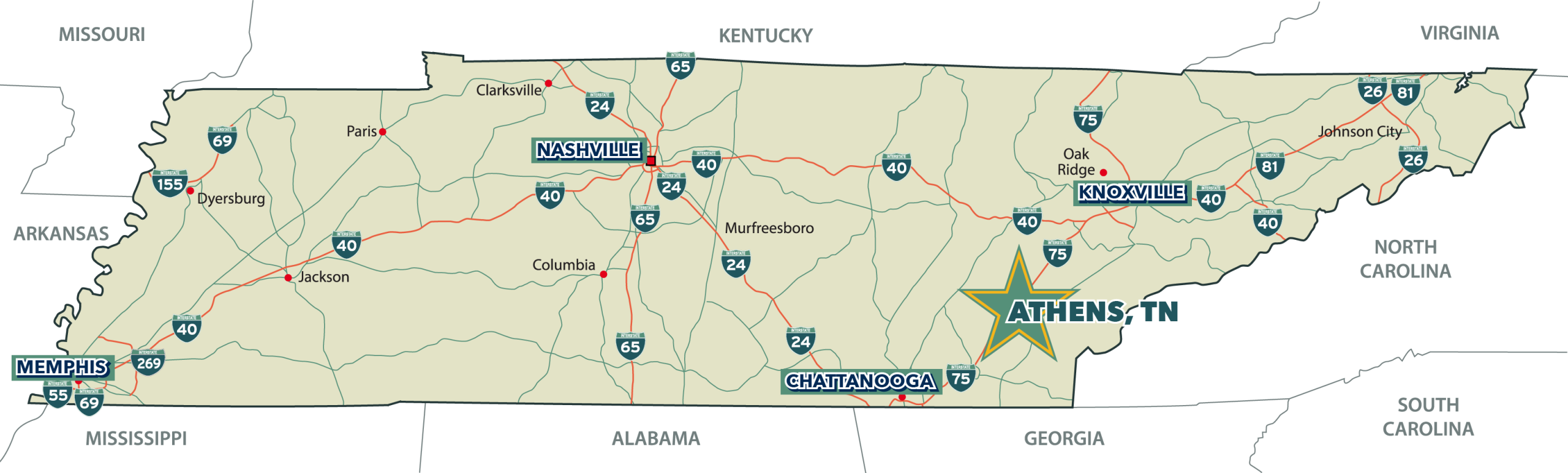
Today, Athens is a thriving community of 15,000 people within 16 square miles, located on the busy I-75 corridor midway between Chattanooga and Knoxville, and operating under a council-manager form of government as provided under Chapter 455 of the Private Acts of 1953. The city offers comprehensive public services, hosts many industrial companies including Denso (auto parts), Heil Trailers, and Mayfield Dairy along with significant medical facilities including Starr Regional Medical Center and a four-year university, Tennessee Wesleyan. The city enjoys a vibrant downtown area with many annual festivals, a low cost of living, and high levels of citizen engagement making Athens, “The Friendly City.”